STEM Learning through Science-in-Action™ Video Storytelling
Science video storytelling is increasingly recognized as an innovative, high-impact method for advancing STEM education while simultaneously strengthening the public’s confidence in scientists, their methods and their findings.
Our Science Storytelling Lab’s science-in-action storytelling™ STEM learning model builds on extensive literature on the effectiveness of video storytelling to strengthen students’ STEM identity, agency and belonging and increase public trust in science.
Science-in-action video storytelling has emerged as a powerful pedagogical and public-engagement tool that bridges STEM learning with science communication, drawing on cognitive theories of multimedia learning and narrative processing to make complex scientific content more accessible, memorable, and emotionally resonant for participating students and broader audiences.
As proof of our Science Storytelling Lab’s STEM learning effectiveness, our lab was recognized by a 2025 New Jersey State Senate resolution for “fostering partnerships between students and university scientists“ and “facilitating a welcoming space in which young people are empowered to explore.”
Our lab’s learning goals for participating students are:
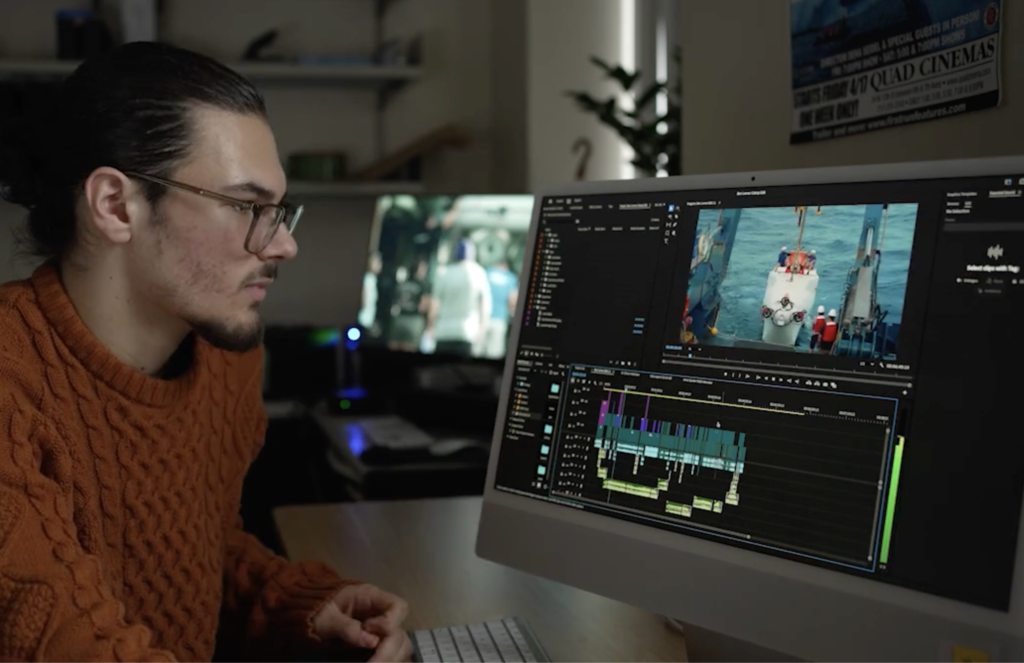
1.) learn to conduct independent research using authentic science video data
2.) engage in new bodies of scientific knowledge in trusting partnership with scientists
3.) partake in team building, collaborative learning and knowledge sharing
4.) develop video storytelling skills proven to increase public trust in science.
Participating storytelling students’ research papers have featured their deepened understanding of a variety of scientific disciplines including plant breeding and genetics, marine science, microbiology and food systems.

Examples of Research on STEM Learning through Digital Storytelling that Support our Science Storytelling Lab’s theoretical framework:
Alismail, H. A. (2015). Integrate digital storytelling in education. Journal of Education and Practice, 6(9), 126–129.
Dahlstrom, M. F. (2014). Using narratives and storytelling to communicate science with nonexpert audiences. Proceedings of the National Academy of Sciences, 111(Suppl. 4), 13614–13620.
Di Blas, N. (2022). Authentic learning, creativity and collaborative digital storytelling: Lessons from a large-scale case-study. Journal of Educational Technology & Society, 25(2).
ElShafie, S. J. (2018). Making science meaningful for broad audiences through stories. Integrative and Comparative Biology, 58(6), 1213–1223.
Franz, N. (2016). The Extension storyteller: Using stories to enhance meaning and catalyze change. The Journal of Extension, 54(3).
Hendriks, F., Kienhues, D., & Bromme, R. (2016). Trust and communication in a digitized world. In B. Blöbaum (Ed.), Progress in IS (pp. 143–159). Springer International Publishing.
Hoban, G., Nielsen, W., & Shepherd, A. (Eds.). (2015). Student-Generated Digital Media in Science Education: Learning, Explaining and Communicating Content. Routledge.
Humm, C., Schrögel, P., & Leßmöllmann, A. (2020). Feeling left out: Underrepresented audiences in science communication. Media and Communication, 8, 164–176.
Jabbar, A. (2026). Digital storytelling as a 21st century pedagogical strategy. Preprints.org.
Jamissen, G., Hardy, P., Nordkvelle, Y., & Pleasants, H. M. (2017). Digital Storytelling in Higher Education: International Perspectives (1st ed.). Springer International Publishing.
Jewitt, C. (2012). An introduction to using video for research (NCRM Working Paper). National Centre for Research Methods.
Kakungulu, S. J. (2024). The role of digital storytelling in education: Enhancing literacy and communication skills. Eurasian Experiment Journal of Scientific and Applied Research, 5(2), 36–39.
Lam, J. Z., & Yunus, M. M. (2023). Student-produced video for learning: A systematic review. Journal of Language Teaching and Research, 14(2), 386–395.
Martin, K., Davis, L., & Sandretto, S. (2019). Students as storytellers: Mobile-filmmaking to improve student engagement in school science. JCOM, 18(05), A04.
Martinez-Conde, S., et al. (2019). The storytelling brain: How neuroscience stories help bridge the gap between research and society. Journal of Neuroscience, 39(42), 8285–8290.
Mayer, R. E. (2005). Cognitive theory of multimedia learning. In R. E. Mayer (Ed.), The Cambridge Handbook of Multimedia Learning (pp. 31–48). Cambridge University Press.
Molder, A. L., Anderton, B., Howell, E., Goodwin, S., Behrman, S., & Ellefson, M. (2025). Use of personal storytelling in educational videos promotes student engagement and science identity in undergraduate biology courses. Journal of Microbiology & Biology Education, 26(3), e00084-25.
Sezen-Barrie, A., & Huang, Y. (2026). Youth storytelling in climate change education: A systematic review of research designs, pedagogical scaffolding, and digital tools (2014–2024). Environmental Education Research, 1–37.
Speed, C., et al. (2019). Critical thinking through student-created video projects. Innovative Higher Education, 44(5), 431–444.
Suzuki, W., Feliú-Mójer, M., Hasson, U., Yehuda, R., & Zarate, J. M. (2018). Dialogues: The science and power of storytelling. Journal of Neuroscience, 38(44), 9468–9470.
Thomas, S., & Manalil, P. (2025). Digital storytelling and the pedagogy of belonging: Reimagining inclusion in higher education. Frontiers in Communication, 10, 1630596.
Walker, E. B., & Lazar, K. B. (2022). Students as science content creators and evaluators: A case study of video documentary storytelling in science education. Journal of College Science Teaching, 52(2).
Wilson, R. S., Niehaus, A. C., White, J., Rasmussen, A., & Kuchel, L. (2014). A documentary video assignment to enhance learning in large first-year science classes. Presented findings appear in Integrative and Comparative Biology, 49, E325–E325, with a fuller writeup on the pedagogy and 84% student reflection outcome.